
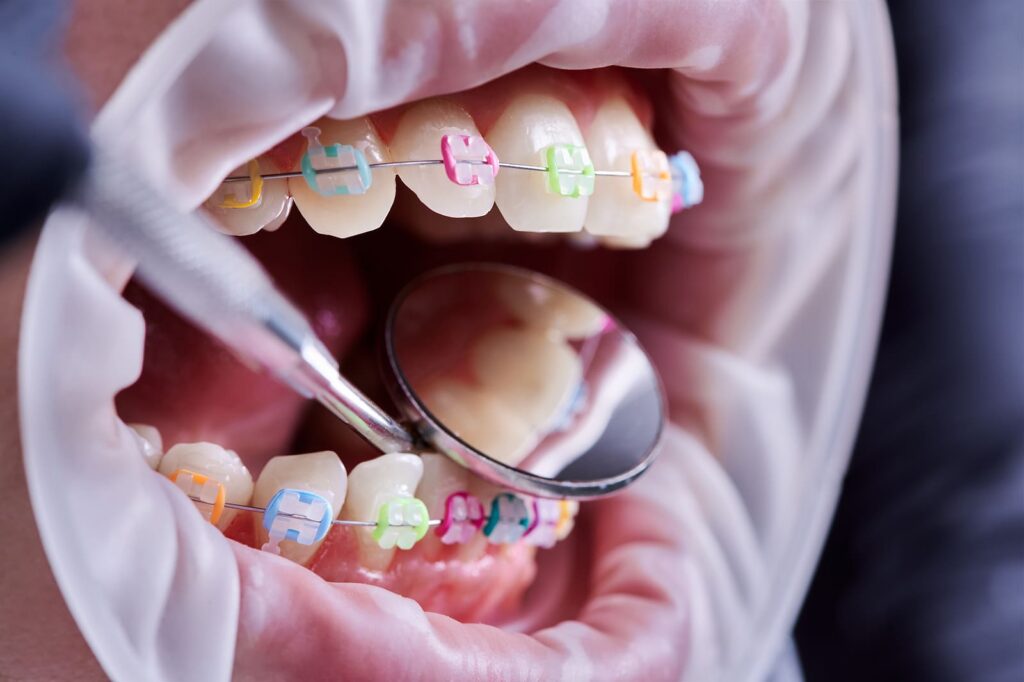

If you are in the middle of braces treatment and your orthodontist has just handed you a little bag of tiny rubber bands with instructions to wear them, you are probably wondering what exactly they are supposed to be doing. The brackets and wires you already understand. But these little loops that hook between your upper and lower teeth? Less obvious.
So what do rubber bands do for braces, exactly? Orthodontic rubber bands, also called elastics, are doing something the brackets and wires simply cannot do on their own: they apply force across both arches at once, guiding the way your upper and lower teeth fit together. Here is the practical version of what is actually happening in your mouth.
What Rubber Bands Actually Do
Your braces are designed to move individual teeth and align them within each arch. The brackets and archwire work within the upper teeth or within the lower teeth. What they cannot do on their own is change the relationship between the two arches, which is exactly what determines your bite.
Rubber bands create an additional force vector that crosses the gap between your upper and lower jaws. By anchoring to hooks on specific brackets, they pull the jaw in a controlled direction over time. That gradual, consistent pressure encourages the bone to remodel, the teeth to shift, and the arches to align in a way that produces a functional, balanced bite.
Without rubber bands, many patients would finish treatment with straight teeth that do not actually meet correctly. Good alignment within each arch is only part of the picture.
What Problems Do Rubber Bands Correct?
The specific issue orthodontic rubber bands are addressing depends on your bite and how your orthodontist configures them. Here are the most common applications:
| Bite Issue | What It Means | How Rubber Bands Help |
| Overbite | Upper teeth close too far over lower teeth | Pull lower jaw forward, reduce vertical overlap |
| Underbite | Lower teeth protrude in front of upper teeth | Pull upper jaw forward relative to lower |
| Crossbite | Upper and lower teeth on the wrong side | Apply lateral force to shift arches into alignment |
| Open bite | Upper and lower teeth do not meet at front | Close vertical gap by pulling arches together |
| Midline correction | Upper and lower centers are off | Shift one arch sideways to align the midline |
How Orthodontic Rubber Bands Are Worn

Your orthodontist will show you exactly where to hook your rubber bands based on which teeth they need to influence. The configuration varies by patient, which is why rubber band instructions are personal and should not be copied from a friend in braces.
- Hook one end to a bracket on an upper tooth. Usually to a hook on a canine or molar bracket.
- Stretch the band diagonally or vertically to a hook on a lower bracket. The angle of the stretch determines which direction the force is applied.
- Wear them as instructed, typically 20 to 22 hours per day. Remove only for eating, drinking anything other than water, and brushing.
- Change them at least once a day. Rubber bands lose elasticity over hours of wear. Fresh bands apply a more consistent force.
- Keep a supply with you. You will get through them quickly, and a few hours without them can slow your progress more than you might expect.
Important: Orthodontic rubber bands only work when they are being worn. Missing hours add up fast. If your treatment feels like it is not progressing, inconsistent rubber band wear is one of the most common reasons.
Why Do Rubber Bands Come in Different Sizes and Strengths?
If you look closely at your rubber band packaging, you will notice they are labeled by size and often by a force measurement in ounces or grams. This is not random. Different corrections require different amounts of force, and the distance between the hooks being connected determines which band size works correctly.
Your orthodontist selects the right combination for your case. Using a stronger band than prescribed does not speed things up. It creates uncontrolled force that can move the wrong teeth, cause discomfort, and actually set your treatment back. Wear exactly what you are prescribed.
When in Treatment Do Rubber Bands Usually Start?
Rubber bands typically enter the picture somewhere in the middle stage of braces treatment, once the archwire has done enough work to level and align the individual teeth within each arch. Adding elastics too early, before the teeth have basic alignment, would apply force to a foundation that is not ready for it. If you want to understand the full sequence of what happens at each stage, our braces journey guide walks through the whole process from start to finish.
For younger patients, this timing can interact with jaw growth in useful ways. Early orthodontic treatment sometimes uses elastics or functional appliances to take advantage of the growth phase, guiding the jaw into a better position before all the permanent teeth are in. The same mechanics are applied at an earlier window.
For teen patients who are in full braces, rubber band compliance tends to be the single biggest variable that separates on-schedule treatment from treatment that runs longer than expected. The elastics are not punishment. They are doing the most important work of the entire treatment phase.
Questions About Your Braces Treatment in Bloomington?
If you are mid-treatment and have questions about your orthodontic rubber bands, or if you are just starting to explore braces and want to understand what the full process looks like, Bowers Orthodontic Specialists is here to help. Dr. Kurt Bowers and the team have been serving Bloomington-Normal since 1993 and are happy to answer every question, no matter how small it may seem.
Address: 2810 E. Empire St., Suite A, Bloomington, IL 61704
Phone: 309-663-0415
Book Your Braces Consultation at Bowers Orthodontic Specialists
Frequently Asked Questions
Do I have to wear rubber bands the whole time I have braces?
Not necessarily. Rubber bands are added when your bite correction phase begins, which is typically in the middle portion of treatment. Some patients wear them for a few months; others need them for longer, depending on how much bite correction is required. Your orthodontist will tell you how long to expect them as treatment progresses.
What happens if I forget to wear my rubber bands for a day?
Missing a day is not catastrophic, but it does slow things down. The force from orthodontic rubber bands works cumulatively over time. A gap in wear means the teeth you are trying to move lose some of the progress made. Getting back on schedule as quickly as possible matters more than worrying about what was missed.
Can I double up my rubber bands to move things along faster?
No. Using two bands where your orthodontist prescribed one applies uncontrolled force that can damage roots, move the wrong teeth, or create new problems that require correction. Always wear exactly what is prescribed, and contact your orthodontist if you want to discuss whether your progress is on track.
My rubber bands keep snapping. Is that normal?
Occasional snapping, especially during eating or yawning, is normal. If bands are snapping very frequently, check that you are using the correct size and that you are changing them regularly. Bands that are worn too long lose elasticity and become more brittle. If the problem persists, mention it at your next appointment.
Will rubber bands hurt?
There is usually some soreness in the first day or two after starting rubber bands, similar to the soreness when braces were first placed. It tends to ease significantly after that initial adjustment period. If you experience sharp pain or significant discomfort beyond general achiness, contact your orthodontist.