


Spacers, also called separators, create a small amount of room between teeth before an orthodontic band is fitted. A band goes around a tooth, so your orthodontist may need space for it to sit properly.
Not everyone who gets braces needs spacers. Whether you need them, where they go and how long they stay in place depend on the appliance your orthodontist is planning.
If separators are part of your next appointment, understanding their purpose—and what to do if one falls out—can make the experience less confusing.
Why does an orthodontic band need space?
Neighboring teeth can fit closely together. An orthodontic band is a ring fitted around a tooth, often as part of an appliance arrangement. Before placing it, the team may use a separator to create room between that tooth and the one beside it.
The American Association of Orthodontists’ glossary describes separators as small elastic rings or wire loops placed between teeth to create space for bands. This is a specific preparation step. It is different from the broader work braces do to change tooth positions and the bite.
Ask which teeth need bands and what those bands will support. An explanation using your own treatment plan will be more helpful than comparing your appointment with a friend’s.
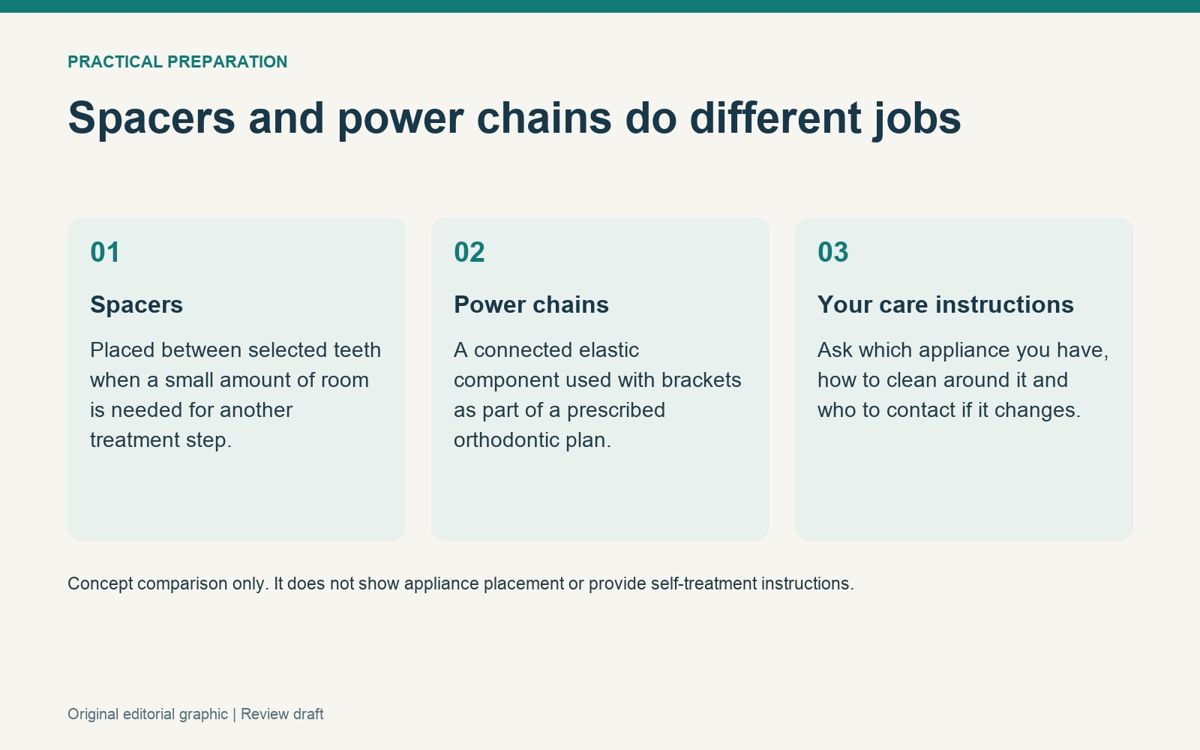
Spacers, power chains and rubber bands do different jobs
Several orthodontic components can look like small rubber rings. Their position and purpose are different.
| Component | Where it may be placed | Main purpose |
|---|---|---|
| Separator or spacer | Between neighboring teeth | Creates room before a band is fitted. |
| Power chain | Across brackets on several teeth | Applies force for planned tooth movements, including closing spaces. |
| Removable rubber band | Between points specified by the orthodontist | Provides prescribed forces as part of the treatment plan. |
Separators are not something to move to another tooth or replace with a household elastic. They also do not replace instructions for any removable rubber bands you have been prescribed.
If you cannot tell which component you are looking at, ask the team to identify it before discussing care.
What happens at a separator appointment?
The team places the separators at the teeth that need space, then gives you instructions for the time before your band-fitting visit. Your experience will depend on the type of separator and the planned appliance.
Before leaving, make sure you know:
- Which teeth have separators and how many were placed.
- When you are expected to return.
- What the next appointment is for.
- How to clean around the separators.
- What food or chewing restrictions apply.
- What to do if a separator is lost or you are uncomfortable.
Ask the clinician to show you the relevant area. A short explanation at the appointment is easier to follow than trying to identify an unfamiliar appliance later.
What might spacers feel like?
You may notice pressure, tenderness or a sensation that something is between your teeth. The amount of discomfort varies, so another patient’s experience is not a timetable for yours.
Discuss comfort measures with the treating team, particularly if you have a medical condition or questions about medicines. A general article cannot choose a pain medicine or dose for you.
If discomfort is marked, worsening or different from the experience the team described, contact the practice. The same applies if you notice swelling or another unexpected change. You do not need to wait until the band-fitting appointment to ask whether something should be checked.
How do you care for teeth with spacers?
Keep up your oral hygiene using the instructions provided for your appliance. The useful question is not simply “Can I brush?” but “How should I clean these particular spaces while the separators are there?”
Ask for a demonstration if you are unsure about brushing, flossing or other cleaning tools near the separator. Also ask which foods or chewing habits could dislodge it. Your clinician can explain the restrictions that apply to your appliance and the short period before the next visit.
Avoid poking at a separator to see whether it moves. Do not test it by pulling on it with your fingers or trying to slide it out. If it feels wrong or looks different, ask the team rather than adjusting it yourself.
What if a spacer falls out?
Call the orthodontic practice. Do not assume that a lost separator always needs immediate replacement, or that it never matters.
Bowers’ orthodontic emergency guidance specifically advises patients to call if they lose a separator so the team can determine whether replacement is needed. The timing of your next appointment and the planned appliance are part of that decision.
When you call, explain which side is affected, when you noticed the separator was missing and when your next appointment is scheduled. Mention any discomfort. If you cannot identify the tooth, describe the area as best you can.
Do not try to push the separator back between your teeth or substitute another object. Get instructions from the treating team.
Does everyone get spacers before braces?
No. The need for separators is related to the planned use of bands and the available space, rather than being a required milestone for every braces patient.
Not needing spacers does not mean your treatment is incomplete. Needing them does not, by itself, tell you that your overall case is more complicated. Your orthodontist can explain the reason they are part of your plan.
Prepare for the next step
Before the band-fitting visit, follow the instructions you were given and contact the practice if a separator has been lost or you have an unresolved concern. The appointment is also a good opportunity to ask how the new appliance will change your cleaning routine and what responsibilities you will have between visits.
Learn more about braces treatment at Bowers Orthodontic Specialists, or contact the team with questions about separators already placed as part of your care.
Frequently asked questions
Does everyone need spacers before braces?
No. Separators are used when the plan needs space for a particular step. The orthodontist decides whether they are appropriate.
Are spacers another name for power chains?
No. A separator sits between selected teeth; a power chain is a connected elastic component used with brackets. Their purposes differ.
How long will my spacers stay in?
Follow the appointment plan supplied by your office. There is no universal duration that applies to every separator and treatment sequence.
Should I put a fallen spacer back myself?
Contact the office for assessment and instructions. Explain which spacer came out and when your next appointment is scheduled.
How should I clean around a separator?
Ask for instructions for the actual appliance and spaces involved. Do not assume every area should be cleaned in exactly the same way while separators are present.