


Your orthodontist may remove a power chain because its current job is complete, because it needs replacing or because the next stage of treatment calls for a different arrangement. The reason depends on your treatment plan. Removal alone does not tell you that something went wrong—or that your braces are ready to come off.
If you left an appointment unsure what changed, the most useful question is simple: “What was the chain doing, and what are we working on next?”
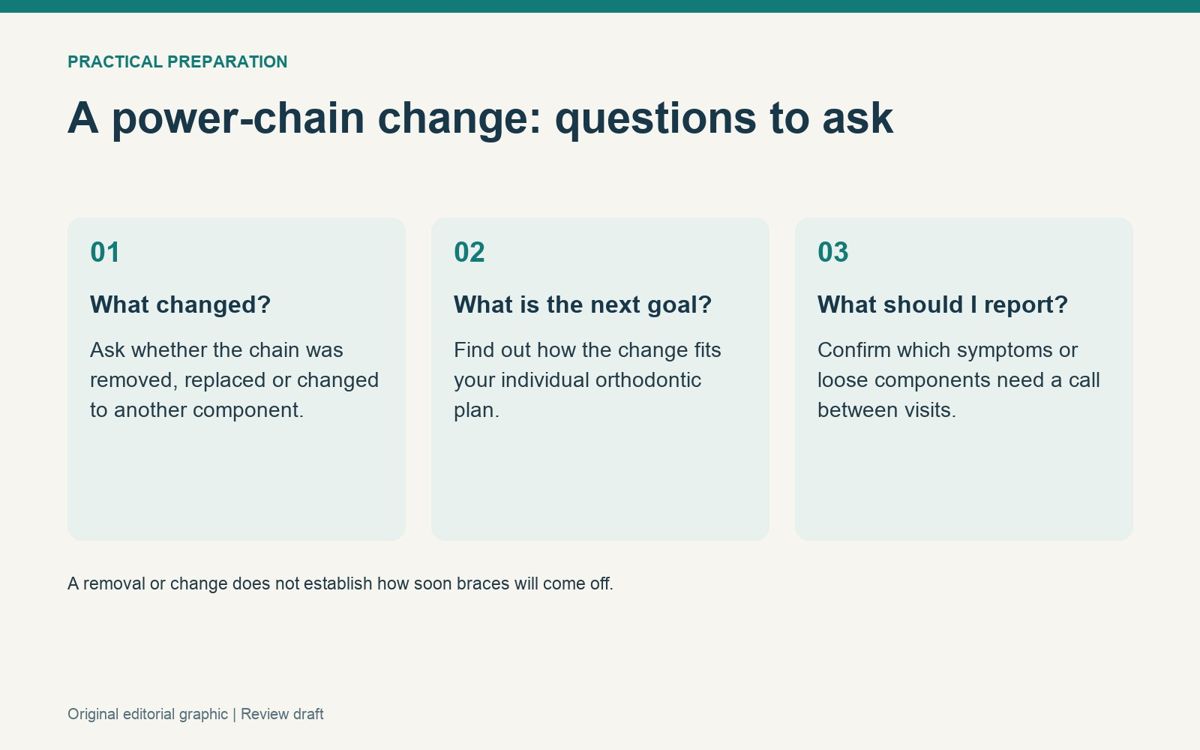
Understanding the appliance can make that conversation easier.
What is a power chain?
A power chain is a connected series of elastic loops that stretches across brackets on several teeth. Your orthodontist may use it to apply force for particular tooth movements, including closing spaces.
The American Association of Orthodontists’ glossary explains that power chains are used for some patients at specific times during treatment. They are not an appliance everyone must have, and they do not necessarily stay in place for the rest of treatment once they are introduced.
Power chains can look similar to other small elastic components. It helps to separate three terms:
| Appliance | What you may notice | Why the distinction matters |
|---|---|---|
| Power chain | Connected elastic loops across multiple brackets | The orthodontic team places and changes it for a particular treatment purpose. |
| Individual elastic ties | Separate small rings around brackets | These hold the wire in place in many bracket systems; they are not a connected chain. |
| Removable rubber bands | Elastics worn between designated hooks or teeth | Patients may be asked to place these themselves according to specific instructions. |
If your orthodontist removes a chain, that does not automatically change instructions for removable rubber bands. Follow the directions you were given for each appliance separately.
Why a chain may change at an appointment
Your clinician is assessing tooth positions, spaces and the way the bite is progressing. The elastic arrangement is one part of that plan. Here are possible explanations to discuss, rather than conclusions you can draw from looking in the mirror.
Its current purpose may have been achieved
If a chain was being used to help close a space, your orthodontist may decide it has completed the movement needed at that stage. Other work may still remain, including changes elsewhere in the mouth or refinement of how the teeth meet.
Ask whether the treatment goal for that part of the mouth has been reached and how the next stage will be managed. A space looking smaller is useful context for the conversation, but it is not a complete assessment of treatment progress.
The appliance may need replacement or a different arrangement
Removing an existing chain during an adjustment does not always mean power-chain use has ended. Your orthodontist may replace it or change which teeth are connected.
If the new arrangement looks different, ask what changed and whether it affects any care instructions. Do not use the previous appearance as a template for trying to restore it yourself.
The treatment plan may be moving to a different task
Braces treatment involves more than closing visible gaps. The team may be concentrating on a different movement or checking the bite before deciding on the next adjustment.
The visible appliance does not show every part of that decision. A patient beside you may have a different elastic arrangement because their needs differ, even if you both started braces at a similar time.
For the wider sequence of care, Bowers’ braces journey guide explains the progression from assessment through active treatment and retention.
Does removal mean your braces will come off soon?
It may be one sign that a particular step is complete, but it is not a reliable countdown to braces removal. Your orthodontist needs to evaluate the treatment goals as a whole.
Instead of asking the chain to provide a finish date, ask which goals remain. You might discuss whether the team is monitoring spaces, individual tooth positions or how your upper and lower teeth meet. Then ask what will be reviewed at the next appointment.
This gives you a clearer picture of progress without turning a single appliance change into a promise about timing.
What should you do after the chain is removed?
Continue the care and appliance instructions given by your treating team. Do not add a chain, put an old one back or change your removable rubber-band pattern to compensate for its removal.
If you are uncertain which instructions still apply, contact the practice. It is reasonable to ask the team to repeat or write down what you should do between visits.
You can use this short appointment checklist:
- What was the power chain doing?
- Was it removed for replacement, a new treatment stage or another reason?
- Are any instructions for removable elastics changing?
- Is there anything different about cleaning this area?
- What changes should I report before my next appointment?
What if the chain broke or came off between visits?
A chain removed by the orthodontic team and a chain that breaks at home are different situations. If it breaks, comes loose or is associated with an unexpected problem, contact the practice for advice rather than assuming it was no longer needed.
Describe what happened, which part of the mouth is affected and whether anything is uncomfortable. The team can determine whether you need an earlier assessment. Do not pull on the remaining appliance or attempt to reconnect it.
Get an explanation tied to your own treatment
You do not need to know every appliance term to ask good questions. “I noticed the chain is gone—what does that mean for my plan?” is enough to start.
Bowers Orthodontic Specialists provides braces treatment in Bloomington. If you have questions about a recent adjustment, contact the team so they can explain the change using your own treatment records.
Frequently asked questions
Is a power chain the same as removable rubber bands?
No. A connected chain used with brackets and removable interarch elastics have different roles. Ask which component your instructions refer to.
Does removing the chain mean treatment is finished?
No. It can reflect a change in the individual plan. The orthodontist still needs to assess the remaining goals and bite.
Should I change my rubber-band routine afterward?
Follow the instructions given for your case. Ask whether anything changed rather than adjusting elastics because the power chain was removed.
Can I replace a broken chain myself?
Do not improvise a replacement. Contact the office and describe what changed so the team can decide the next step.
What is the most useful question at the next visit?
Ask what the chain was doing and what the next stage is intended to accomplish. That connects the appliance change with your treatment goals.