
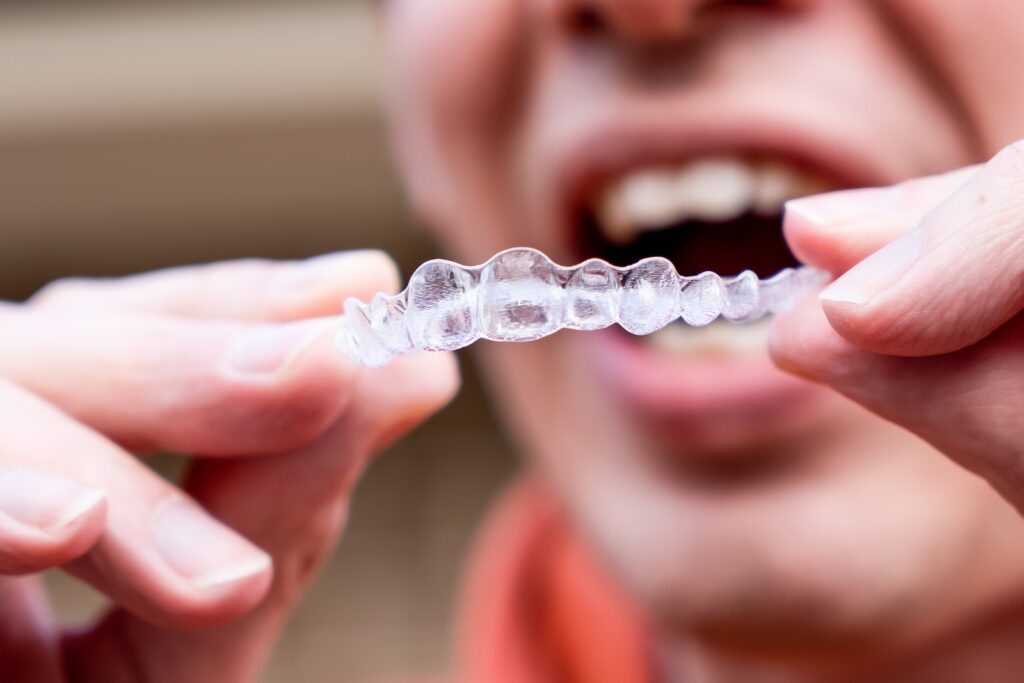

Most patients change Invisalign trays every seven to fourteen days, and your orthodontist sets which of those two intervals applies to you. If you are considering Invisalign in Bloomington, IL, the interval is not a fixed rule of the system. It is a clinical decision based on how your teeth respond, how complex the planned movements are, and how consistently you wear the trays.
Key Takeaways
- A weekly change schedule is now the most common starting point, with fourteen days used where a case needs more settling time between stages.
- The interval can be adjusted mid-treatment in either direction. Being moved to a longer interval is not a setback.
- Consistent wear is important for keeping treatment on track. Bowers Orthodontic Specialists recommends wearing Invisalign aligners for 20–22 hours a day.”Wear time drives everything. Twenty to twenty-two hours a day is what makes any interval work.
- A tray that still feels tight at the end of its cycle is a signal to raise with your orthodontist, not to push through on schedule.
- Refinement trays at the end of treatment are normal and are usually planned for from the start.
What actually happens when you change a tray
Each aligner in your series is manufactured slightly differently from the one before it. When you seat a new tray, it does not passively fit the teeth as they currently sit. It applies light, continuous pressure toward where the teeth need to go next.
That pressure starts a biological process. The periodontal ligament that suspends each tooth in its socket compresses on one side and stretches on the other, and the bone responds by dissolving where the tooth is moving into and rebuilding behind it. That remodelling is why teeth can move at all, and it is also why the process cannot be rushed. The interval between trays is essentially a decision about how much time that bone response needs before the next increment of force is applied.
This is also why the first day or two of a new tray feels tight and the last few days feel loose. The tightness is the force being applied. The looseness at the end means the teeth have caught up.
Weekly or every two weeks: what decides it?
Fourteen days was the original standard, and it is still used. Seven days has become the more common starting point as planning software and materials have improved. Neither is inherently better, and several factors push a case one way or the other.
Your orthodontist will lean toward a longer interval when:
- The plan involves larger movements, particularly rotating canines or premolars, or moving roots rather than just tipping crowns.
- You are an adult. Bone remodelling is generally slower after growth has finished, and adult cases more often use a longer cycle, at least at the start.
- There is a history of gum disease or reduced bone support, where lighter, slower force is safer.
- Your trays are consistently still tight at the end of the cycle, which means the teeth have not finished tracking.
A shorter interval suits cases where:
- Movements are small and straightforward, such as mild crowding or minor spacing.
- You are a teenager or young adult in active growth, where bone turns over faster.
- Your wear time is consistently high, and your trays are seating fully.
The honest summary is that the interval is chosen at the start from the treatment plan and then adjusted based on how your teeth actually behave. If your orthodontist changes it, that is the system working rather than a problem.
| Weekly changes | Every two weeks | |
|---|---|---|
| Typical use | Simpler movements, younger patients, high compliance | Larger or rotational movements, adult cases, reduced bone support |
| Trays in a two-yeartwo year plan | Roughly one hundred | Roughly fifty |
| Discomfort pattern | More frequent, shorter episodes | Less frequent, each slightly more noticeable |
| Tolerance for a missed day | Lower. The schedule has less slack | Higher. There is more built-in settling time |
| Office visit frequency | Similar. Visits are set by monitoring needs, not tray count | Similar |
What if a tray still feels tight when it is due to change?
Do not force the next one in. A tray that remains tight at the end of its cycle usually means the teeth have not fully tracked to where that stage intended, and moving on stacks the shortfall into the following tray. Over several stages, that is how aligners stop seating properly and how treatment falls behind.
The right response is to contact the office. In most cases, the answer is simply to wear the current tray for a few more days. Sometimes your orthodontist will want to see you to check whether an attachment has come off, since a lost attachment removes the grip the tray needs on that tooth. Occasionally the plan itself needs adjusting.
A useful habit is the chewie: a small soft cylinder you bite on for a few minutes after seating a tray, which helps the aligner settle fully onto the teeth. Poor seating at the back is a common and easily missed reason a tray underperforms.
Does changing trays more often speed up treatment?
Changing trays earlier than instructed does not necessarily shorten treatment and may affect how well the next aligner fits.No, and doing it on your own initiative is the most common way patients damage their own results. The interval is not a delay built into the process. It is the time the bone needs. Changing early means the next tray applies force before the previous movement has stabilised, and the teeth progressively stop matching the trays.
The American Association of Orthodontists is clear that orthodontic tooth movement is a biological process with a rate limit, and the American Dental Association makes the same point about fixed appliances. What genuinely keeps treatment on schedule is unglamorous: wearing the trays for the full twenty to twenty-two hours, keeping every appointment, and not losing attachments to hard food.
If treatment length is your priority, the conversation to have at your consultation is about the plan, not the tray schedule. Some cases finish faster with braces.
How wear time interacts with the schedule
Twenty to twenty-two hours a day is the requirement, and it is what makes any interval work. That leaves roughly two hours across the entire day for meals and cleaning combined, which is tighter than most people expect.
Trays come out for all food and for any drink other than plain water. Hot drinks matter twice over, because heat can distort the plastic and permanently alter the fit, and coloured drinks stain it. Brush before the trays go back in. If brushing is not possible, rinse thoroughly.
A practical guideline is to keep each removal to about thirty minutes. Three meals at half an hour, plus cleaning time, fits inside the daily budget. Meals that stretch to an hour do not, and the shortfall compounds across a week.
If you do fall behind on a tray, tell your orthodontist rather than quietly extending it. The fix is usually straightforward when it is caught early. Our guide to cleaning Invisalign step by step covers the daily routine in more detail.
Where refinement trays fit in
Most comprehensive plans end with a refinement stage. New digital impressions are taken, a further short series of trays is produced, and the final details are corrected. This is normal; it is anticipated in most treatment plans, and it is not evidence that anything went wrong.
The tray interval during refinement is often shorter, because the movements are smaller. Ask at your consultation whether refinements are included in the quoted fee, since that is one of the items that most often differs between quotes.
Bowers Orthodontic Specialists in Bloomington, IL
Dr. Kurt T. Bowers, D.D.S., M.S., has been in private practice in Bloomington since 1993. He earned his Bachelor’s degree, Doctor of Dental Surgery degree, Master’s degree, and Specialty Certificate in Orthodontics and Dentofacial Orthopedics all from the University of Iowa, and he is a Diplomate of the American Board of Orthodontics and Dentofacial Orthopedics. He is a member of the American Association of Orthodontists and the American Dental Association, and a past president of the McLean County Dental Society.
The practice is at 2810 E. Empire St., Suite A, Bloomington, IL 61704, and also serves patients from Normal and the surrounding communities. If you are still weighing appliances, our comparison of Invisalign and braces treatment time sets out how the two differ, and financial options cover how treatment is paid for.
Frequently asked questions
How often do you change Invisalign trays?
Most patients change trays every seven to fourteen days, with weekly being the more common starting point. Your orthodontist sets the interval from your treatment plan and adjusts it based on how your teeth respond. It is a clinical decision rather than a fixed rule, and it can change during treatment.
Can I change my aligners early?
No. Changing early applies force before the bone has finished remodelling around the previous movement, and the teeth progressively stop tracking with the trays. It does not shorten treatment. If you want to discuss the pace of your plan, raise it with your orthodontist rather than adjusting the schedule yourself.
What if I forget and wear a tray too long?
A few extra days usually cause no harm, and it is sometimes exactly what is recommended when a tray is still tight. Wearing one tray for several weeks without advice is different, because your plan depends on progressing through the sequence. Call the office and ask rather than guessing.
Why does the new tray hurt for the first day?
Because that is the force being applied. Soreness typically peaks within the first 24 to 48 hours after a new tray and then eases as yourtwenty-four to forty-eight hours of a new tray and then eases as the teeth respond. Changing trays in the evening helps, since the first hours pass while you are asleep.
How many trays will I need in total?
It depends on the number of movements and the interval. A two-year plan on a weekly schedule runs to roughly one hundred trays, while a two-week interval halves that. Shorter cases use far fewer. Refinement trays at the end add to the count and are normal.
Do I still need to wear the tray while eating?
No. Aligners come out for all food and for any drink other than plain water. Eating with them in can crack the plastic and trap sugar and acid against the enamel. Brush or at least rinse before putting them back in.
What happens if I lose a tray?
Contact the office the same day. Depending on how far through the stage you are, you may be advised to go back to the previous tray, move forward to the next, or wait for a replacement. Do not simply leave the trays out while you decide, because teeth begin to settle back within hours.
Does the interval change during treatment?
Often, yes. Many plans start on one interval and adjust once your orthodontist sees how your teeth are tracking. Being moved to a longer interval is not a setback. It means the plan is being matched to your biology rather than to a template.
Will I need retainers afterwards?
Yes, and indefinitely. After treatment, the ligament and bone need a long period to reorganise at the new position, and teeth carry a real tendency to drift back, strongest in the first year. Retainers are worn full time initially and then at night on an ongoing basis.
Considering Invisalign in Bloomington, IL? Dr. Bowers offers consultations for patients of all ages. Call 309-225-3222 for new patients or 309-663-0415 if you are already with the practice, or book a smile consultation online.